Case study · with Mercedes-Benz Design · TU Eindhoven
Glide
As cars begin to drive themselves, passengers lose the one thing that made them comfortable: a sense of control. Glide gives it back: a tangible interface that lets everyone in the car shape the driving style, and feel the others doing the same.
- Role
- Individual master’s final project: every part, from research to working prototype
- Partner
- Mercedes-Benz Design (Advanced UX), Sindelfingen
- Timeline
- September 2024 to January 2025
- Scope
- Concept · Interaction design · GUI · Tangible interface · Working prototype
01Research
Autonomous driving research keeps circling the same question: how do we make passengers trust the machine? Most concepts answer with information: screens explaining what the car is about to do.
Before any of that, a survey of 143 people asked a plainer question about the cars we already have. Only 11 percent had never been uncomfortable as a passenger. The rest named why: risky overtaking and insecure driving style, a distracted driver, plain speed. Two thirds said they mention it to the driver half the time at most, usually less. And 114 of them said they wished there were some way to say it at all.
That is the finding the whole project stands on. The problem is not that passengers lack information about the drive. It is that they have no acceptable way to influence it, and it predates autonomy entirely. A literature review and co-creation sessions with automotive UX experts then narrowed the territory to control distribution: who in the car gets to influence what, and how conflicts between preferences should feel. Passengers want agency, but a car with five equal drivers is a car nobody trusts.
Trust doesn’t come from being informed. It comes from having a say.
02Concept
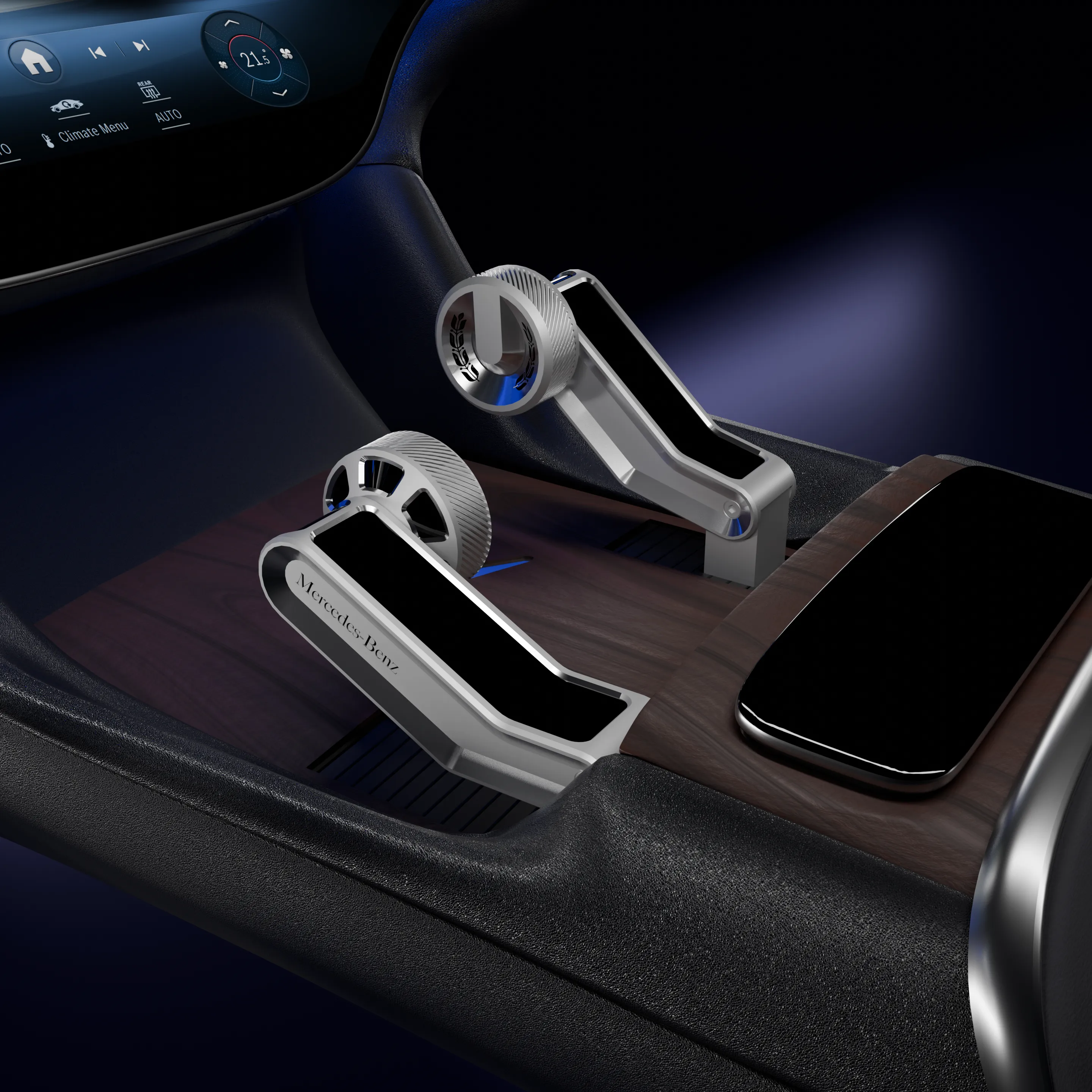
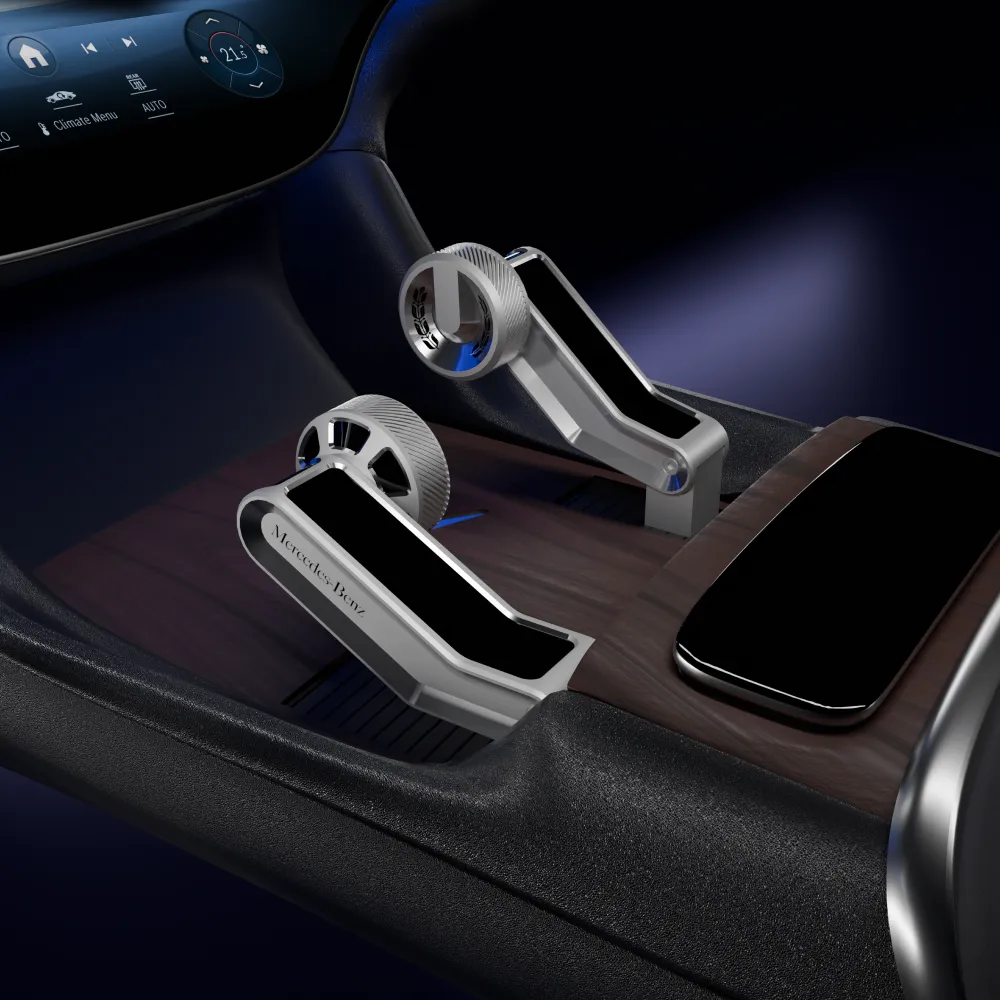
Glide resolves that tension with role-differentiated shared control. The driver keeps authority: they set the driving style and define a range around it. Within that range, every passenger fine-tunes the parameters that shape how the ride feels (following distance, acceleration, top speed) from a tactile handle at their seat.
The second half of the concept is social: the handles are haptically linked. When another passenger nudges the car toward a calmer ride, you feel the preference arrive in your own hand: a quiet negotiation through force, not through an argument over a touchscreen.
03Form
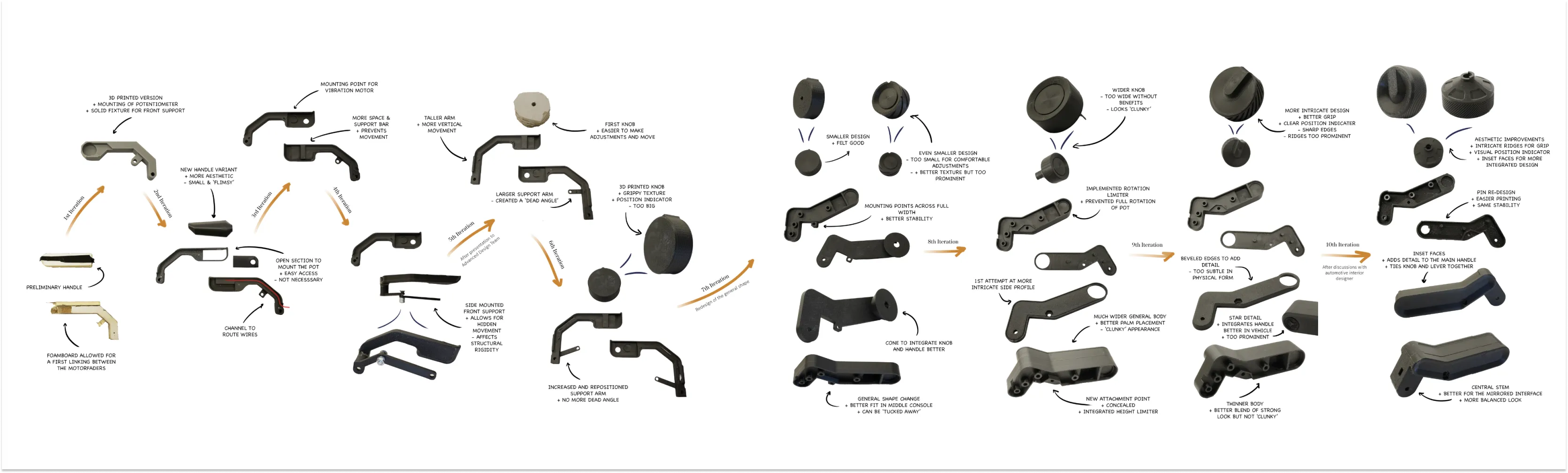
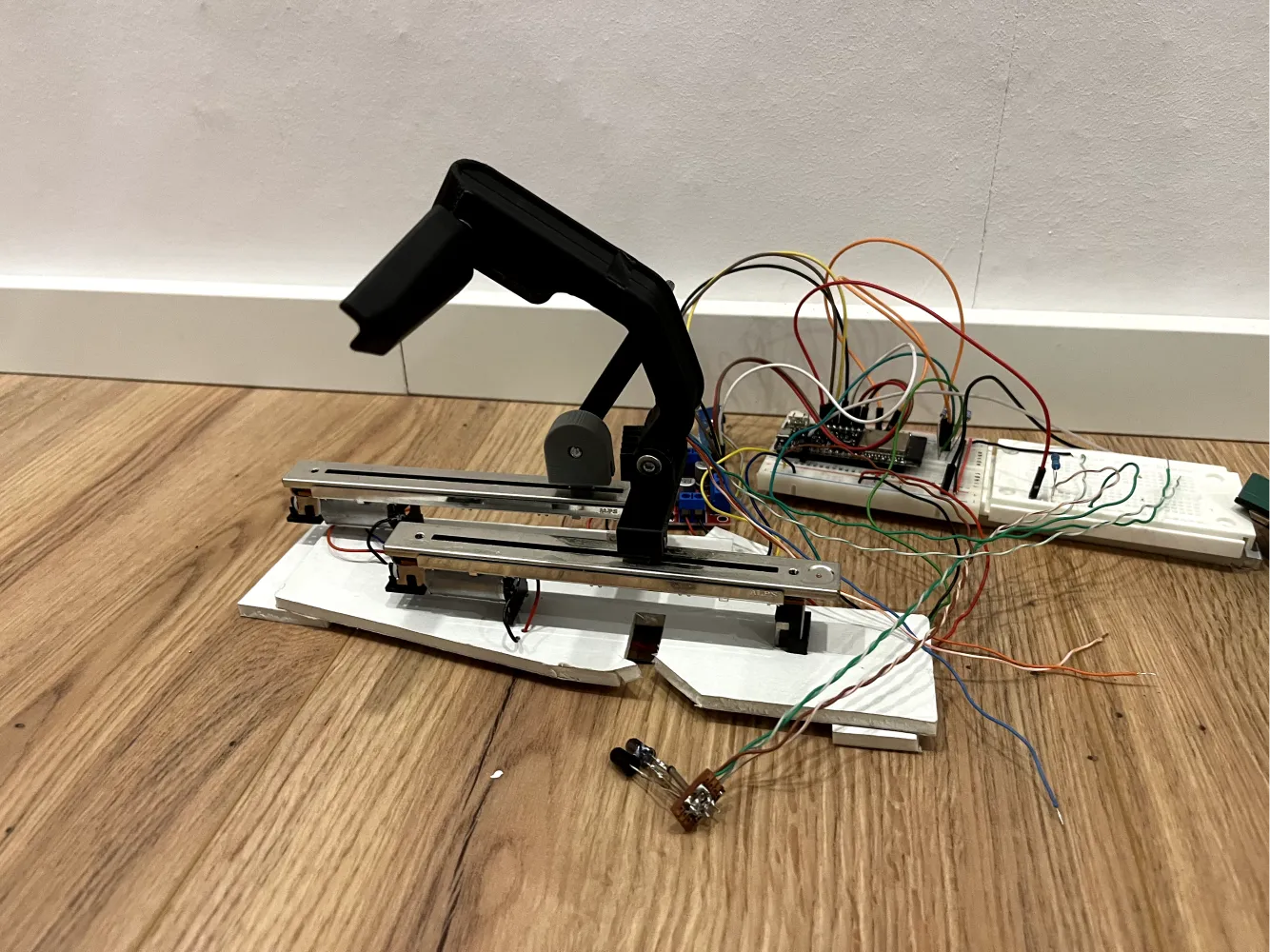
The handle went through ten iterations. It started with a foamboard test prototype that evaluated the movement, and ended in a 3D printed and painted interactive prototype, developed against feedback from Mercedes-Benz interior designers. Each round tuned one variable at a time: mounting stability, grip, knob diameter, the ridge detail that tells your fingers where the position indicator sits.
The end state looks inevitable, which is the point. A control this small only feels premium and intuitive when nothing about it needs explaining.
04Interface
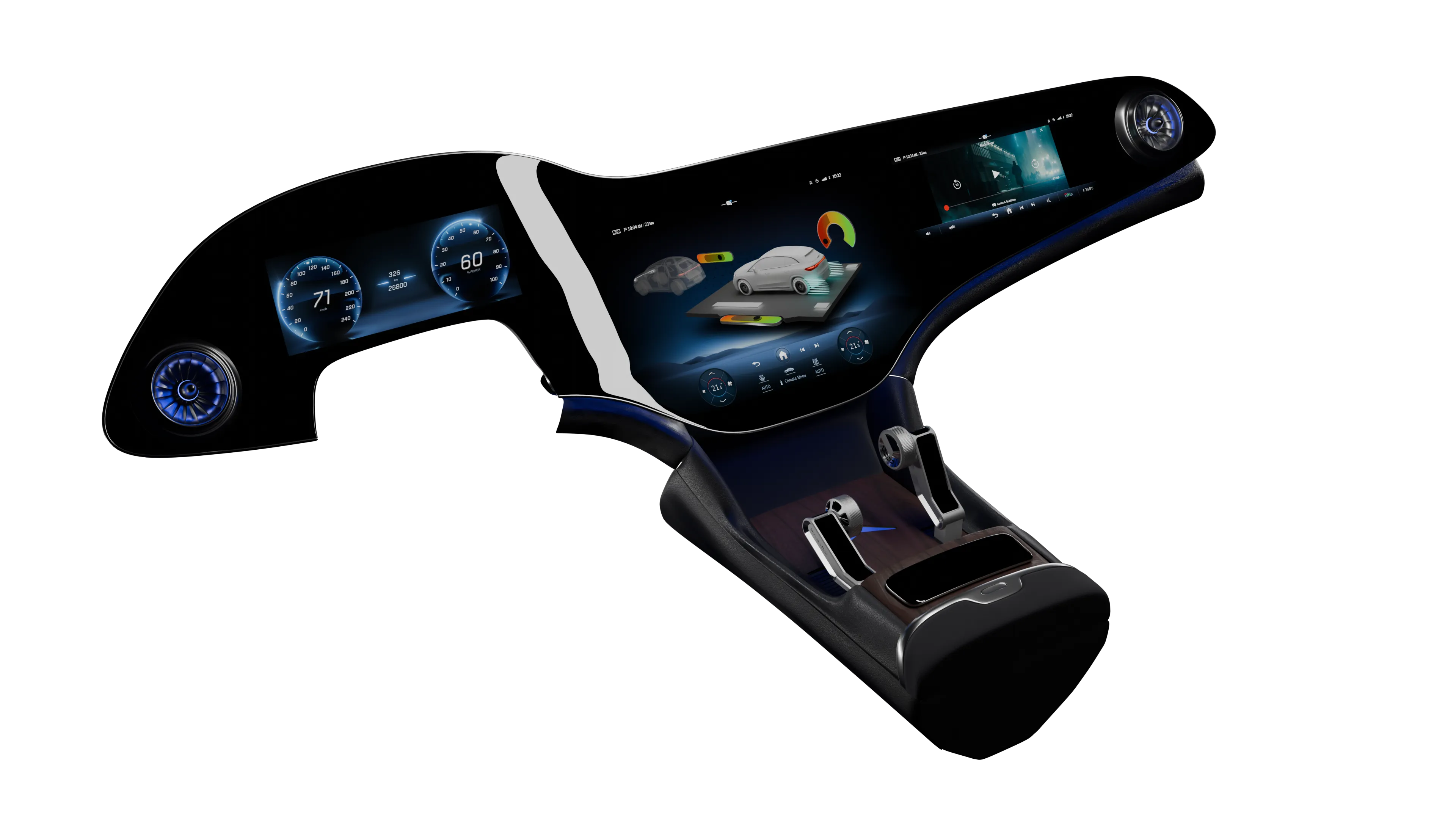
The graphical interface is the handle’s visual counterpart: a centre-screen scene, turned interactive in ProtoPie with assets modelled in Blender, that shows the car’s behaviour changing as passengers adjust their handle. Distance, acceleration and speed read as physical space around a rendered car.
Because every passenger’s input is visible in one shared scene, the interface does socially what the haptics do physically: it keeps the negotiation over the ride in the open.
05Build
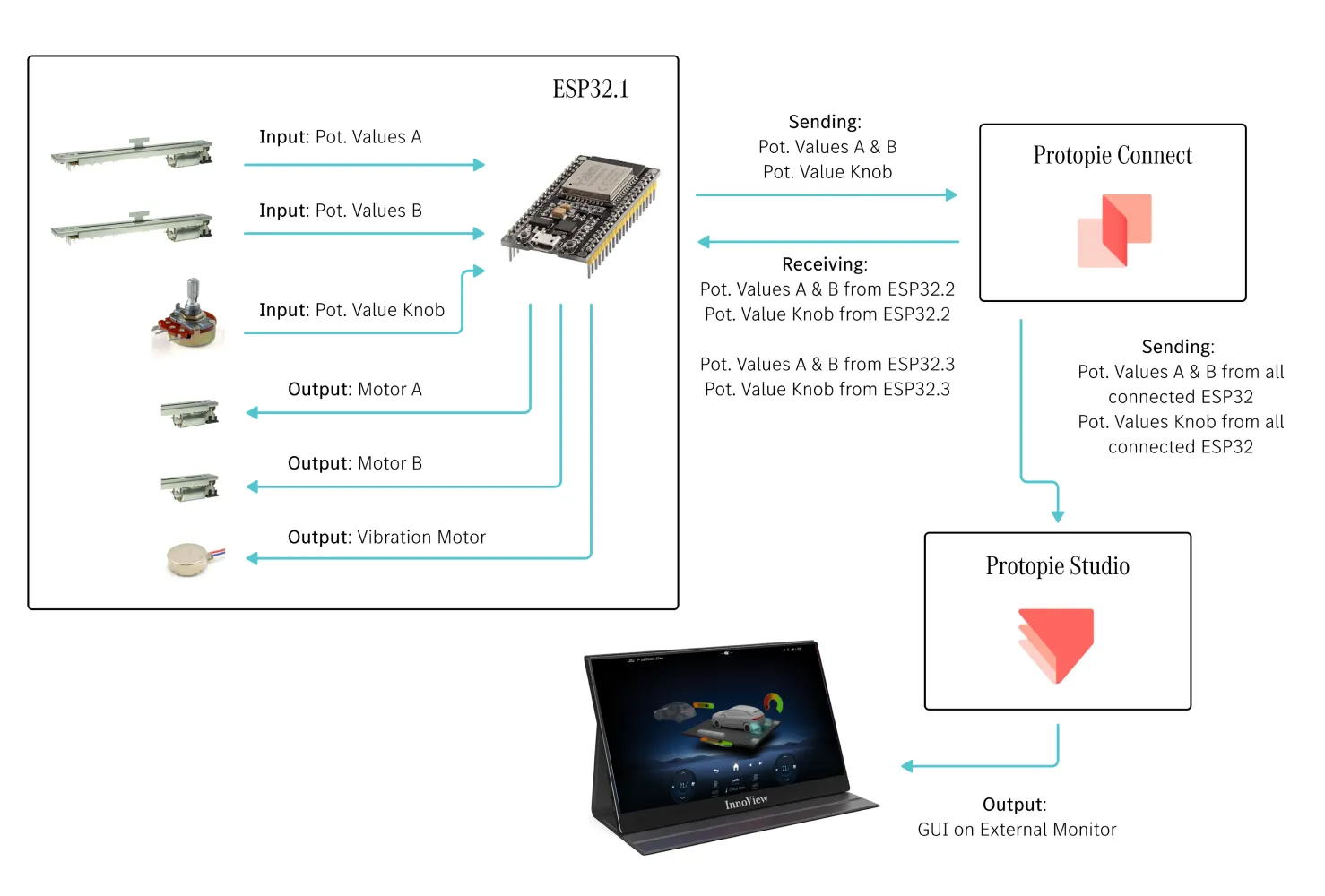
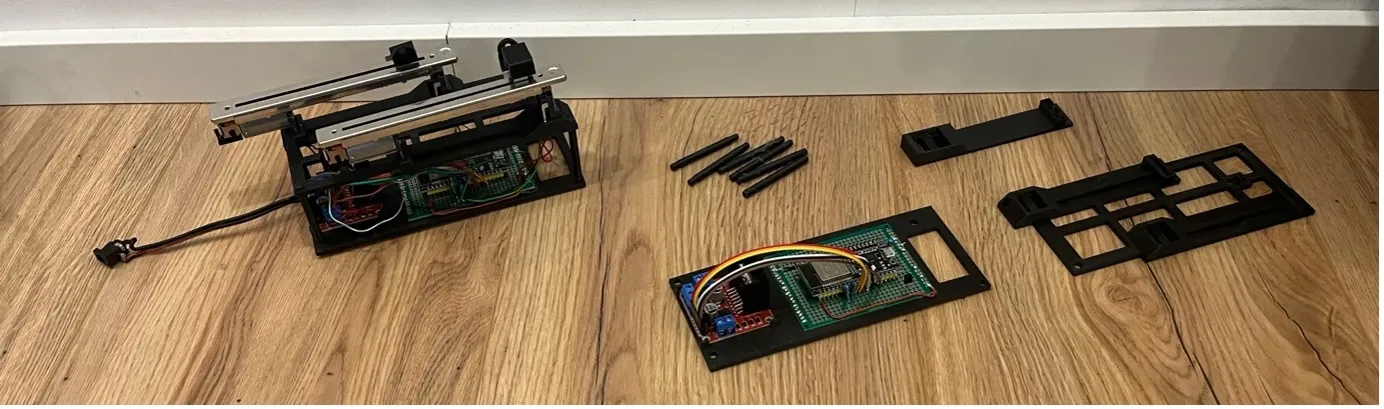
Under each handle sit two motorfaders mounted side by side, giving motorised force feedback on both axes, while a small vibration motor gives feedback on the third axis. An ESP32 reads the handle and drives the motors, and talks to the GUI via Protopie over Wi-Fi, so a preference set on one handle physically arrives at the other prototypes and the screen follows in real time.
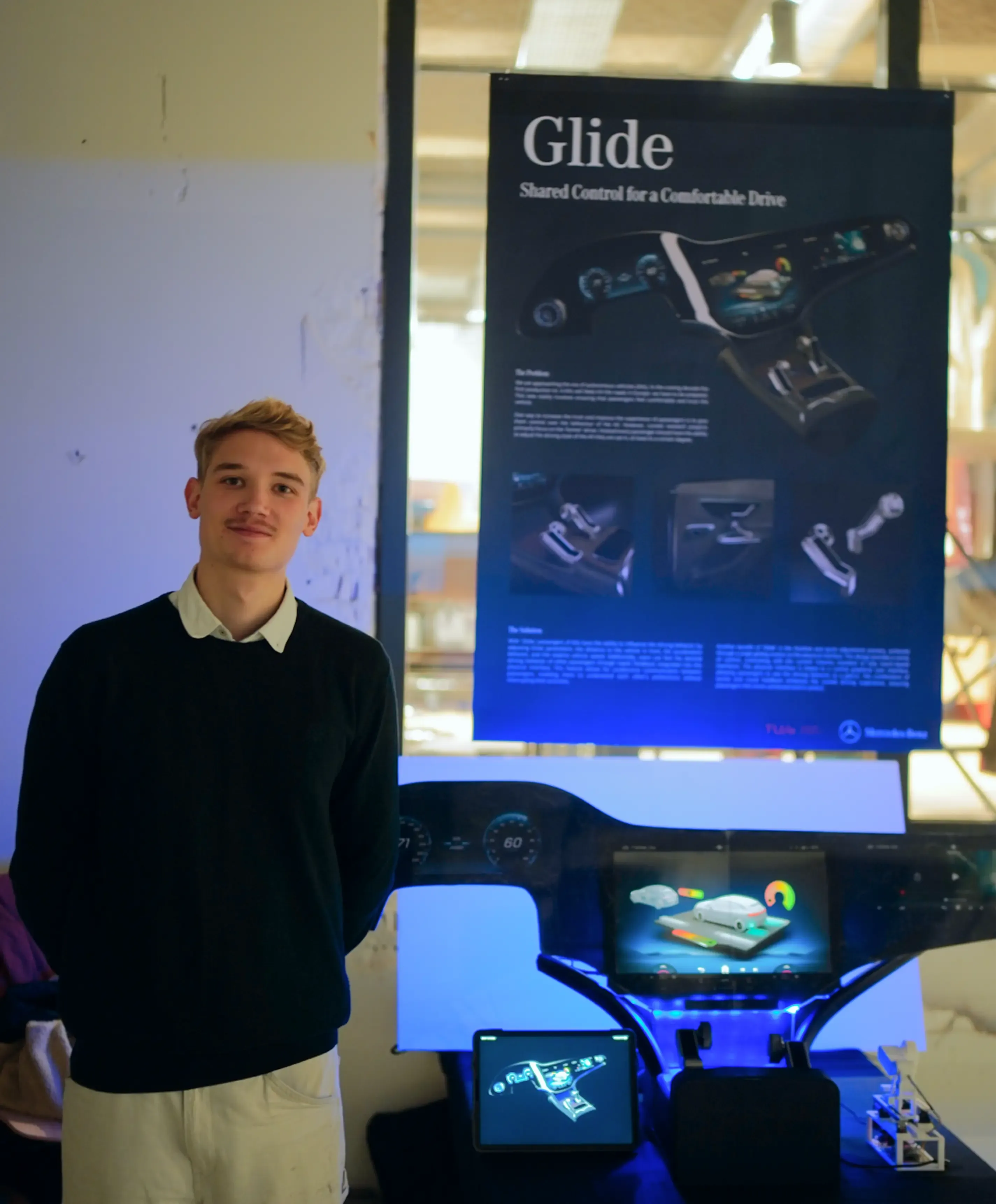
The demonstrator was shown to the Advanced UX Design team at Mercedes-Benz and evaluated with Autonomous Vehicle Design experts.
Outcome
Nine people evaluated the concept: five potential users and four designers working in automotive UX. Eight of the nine agreed the control split gave passengers enough say, and all nine said they would be comfortable using it, on the specific grounds that the driver frames the range first. The parameters divided them. Most thought three was already too fine-grained, and one made the sharpest point in the study: if an adjustment does not produce an effect you can feel, people stop touching it.
The thing worth saying out loud is that the interface did not achieve what it set out to. It aimed to be intuitive and the evaluation found it was not, and the handle itself was never put through direct user testing, which is the limitation that keeps any conclusion provisional. Glide is a first iteration that turns a theoretical control split into something you can put your hand on. That was the hard part, and it works; the intuitiveness is the next iteration’s problem.
His focus on creating a democratic interface for autonomous driving, allowing multiple users to negotiate the driving style of a self-driving car, was both innovative and thought-provoking.
Zane Amiralis
Manager Advanced UX Design, Mercedes-Benz
